ServicesWell Water Filtration
Well Water Filtration in Rancho Palos Verdes
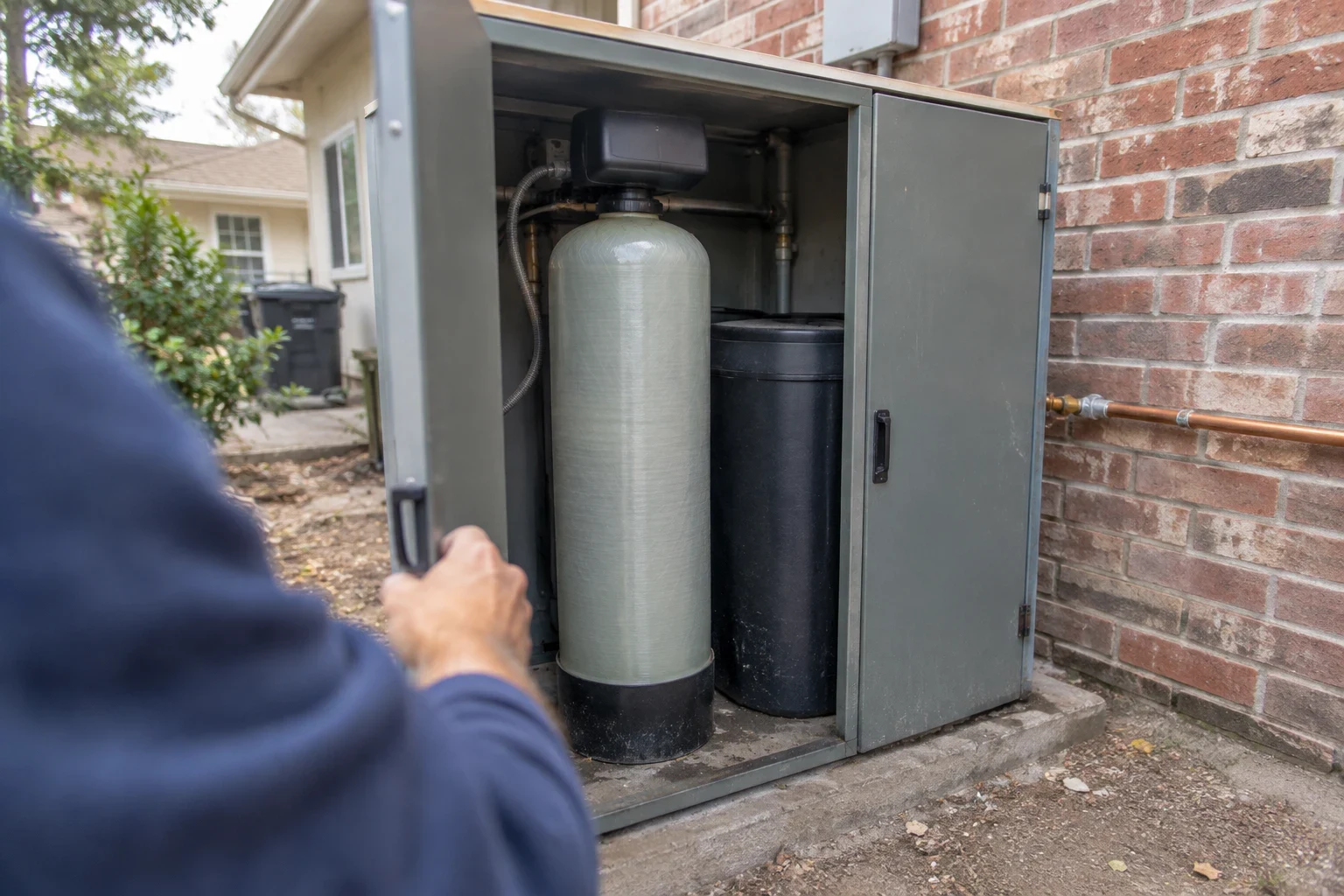
Water from a private well brings up whatever the ground holds: fine sand, dissolved iron, manganese and, in some wells, hydrogen sulfide with its rotten-egg smell. We size each filter stage around the minerals your well carries and the gallons per minute your pump delivers, then plumb it in right after the pressure tank.
What a well filter does, and what it does not
A well system has no utility upstream doing the cleanup. Whatever the pump pulls from the casing goes straight into your home's plumbing. Most problems we see fall into two groups: particles you can catch mechanically, like sand and silt, and dissolved minerals that have to be oxidized into solid form before any media can hold them.
That second group is why a single cartridge housing rarely fixes a well. Dissolved iron passes through a 5-micron sediment filter as easily as clean water. It only turns into the orange flakes you see in the toilet tank once it meets air. A working setup oxidizes first, then filters, then backwashes the trapped iron to drain.
A filter is not a disinfection system. If a lab report on your well shows coliform bacteria, that needs a different fix, and we will tell you so plainly. For drinking water on top of a well filter, many homeowners add our reverse osmosis system at the kitchen sink.
What the installation includes
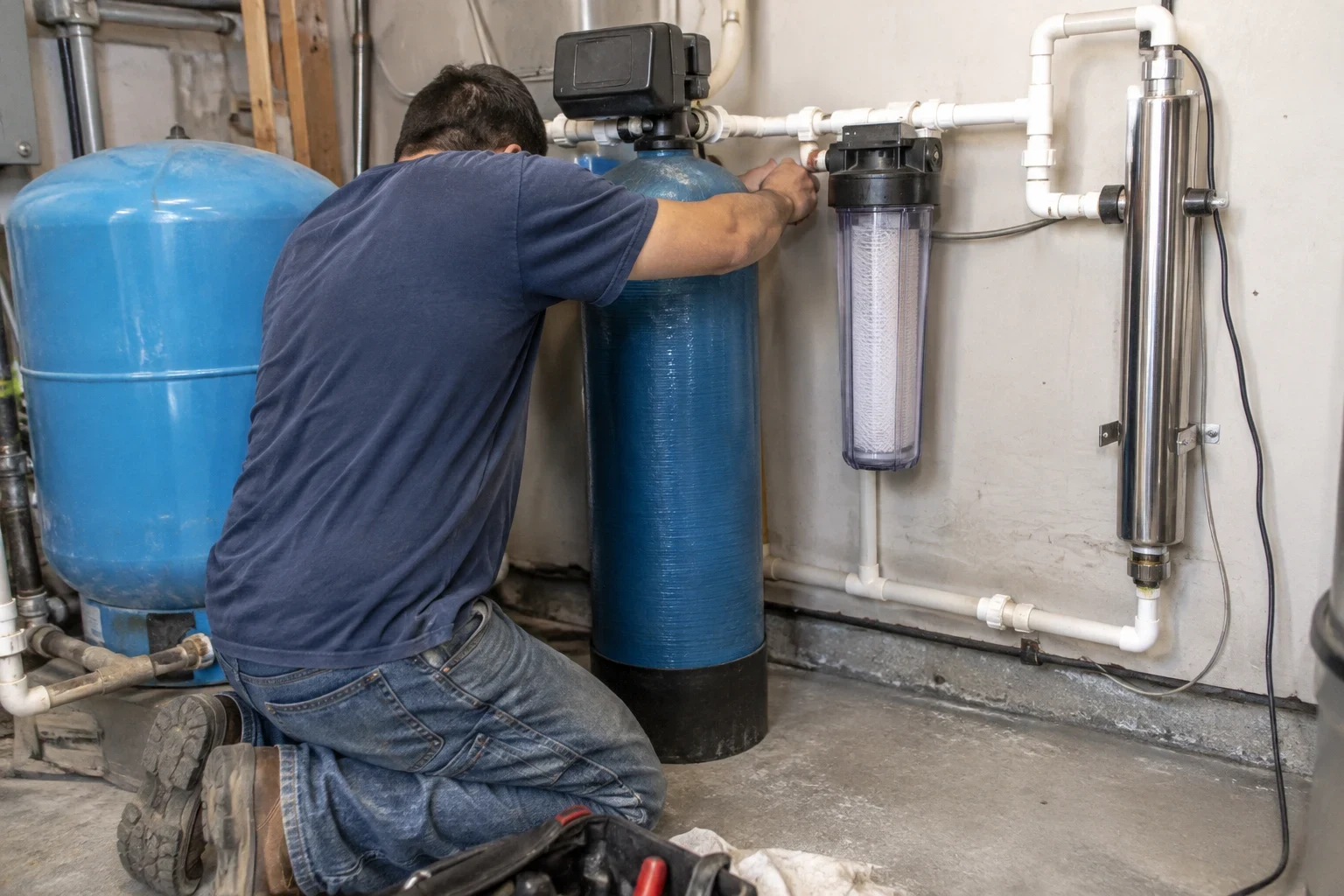
Sediment prefilter
A sediment housing fitted with a spun or pleated polypropylene cartridge stops sand and silt ahead of the media tank. Choose a see-through bowl and you can tell at a glance when the cartridge is filling with grit.
Oxidizing media tank
For iron, manganese and sulfur odor we use an oxidizing media bed that converts dissolved minerals into particles and holds them. The control head backwashes the bed on a schedule so it does not clog.
Bypass valve and unions
Every system gets a three-valve or built-in bypass. If the media ever needs service, you still have water to the house while it is out of the loop.
Backwash drain line
Rinse water from each backwash needs a legal, visible place to discharge. The line ends above the drain with an open gap of air between pipe and receptor, which keeps dirty water from ever being pulled back toward the tank.
Photos of the finished work
We photograph the plumbing before and after so you have a record of what was installed and where, which is useful later for service or for any insurance question about the equipment.
Signs your well water needs filtering
- Orange or rust stains
- Reddish rings in toilets, tubs and on the laundry point to dissolved iron. Bleach often makes iron stains set harder in fabric.
- Black or brown specks
- Dark grit or black staining on fixtures usually means manganese. It tends to show up at lower levels than iron and stains just as stubbornly.
- Rotten-egg smell
- Hydrogen sulfide gives water a sulfur odor, often strongest on the hot side. Oxidizing media handles low to moderate levels well.
- Grit in aerators and valves
- Sand clogs faucet aerators, wears washing machine inlet screens and scores the seats of toilet fill valves. A sediment stage protects all of them.
- Cloudy water after heavy rain
- Turbidity that rises after a storm suggests surface water is reaching the well. Filtration helps with the particles, but it is also worth having the wellhead seal looked at.
How a well filter install runs
- 1
Phone conversation
We ask what you are seeing, how old the pump and pressure tank are, and whether you have any recent lab results. That tells us which media and tank size make sense before anyone drives out.
- 2
Site walk at the pressure tank
We look at the pipe size, the pressure switch setting, where a backwash drain can run and whether there is an outlet for the control head. We measure your pump's flow so the media tank is not undersized.
- 3
Install and startup
We shut off the pump, cut in the sediment housing, media tank and bypass, then run the first backwash to rinse fines out of the new media. Most installs take part of one day, and water is back on before we leave.
- 4
Walkthrough and records
We show you the bypass, the cartridge change and the backwash schedule on the control head. You keep the photos of the finished install for your own records.
What moves the cost
The equipment one well needs can look nothing like what the well next door needs, so we quote only after we know your water and how your plumbing is laid out. With our free install (we cover the cost), labor never appears on your quote. What you pay for is the filter equipment. You hear the numbers by phone before anything goes on the calendar.
- What is in the water
- Sediment alone needs a cartridge stage. Iron, manganese and sulfur together call for a larger oxidizing media bed and a more capable control head.
- Pump flow rate
- A media tank has to backwash at a set flow. A strong pump can use a bigger tank; a weak one may need a smaller bed sized to what it can actually push.
- Space and drain access
- A tight well house or a pressure tank far from any drain means longer runs for the backwash line and sometimes a different tank footprint.
- Condition of existing plumbing
- Corroded galvanized fittings or a failing pressure tank may need attention before a new filter is tied in. We point it out with photos and let you decide.
Well water filtration questions
- Will a well filter make my water safe to drink?
- It removes sediment, iron, manganese and sulfur odor, which fixes most staining and taste complaints. It does not kill bacteria. If you want extra treatment for drinking and cooking, an under-sink reverse osmosis unit is a common second step.
- How often do I change the sediment cartridge?
- It depends on how much sand your well moves. Many homes change it every few months. If the bowl looks brown or your water pressure drops, it is due.
- Will the filter lower my water pressure?
- A correctly sized system causes a small, steady pressure drop you will rarely notice. Big drops come from undersized tanks or clogged cartridges, which is why we measure flow before choosing equipment.
- Does the system need electricity?
- Most backwashing control heads need a standard outlet to run the timer and valve. Cartridge-only setups do not. We check for power during the site walk.
- Iron staining or a failed fitting damaged my fixtures. Will you document it for my insurer?
- Yes. We take photos of the damage and the equipment involved, note what we believe caused it, and hand you that record to include with your claim. Your insurer and its adjuster make the coverage decision, not us. Carriers often treat slow staining differently from a sudden leak, so ask yours how they classify what happened.
Get clear water from your well
Give us a rundown of the stains, smells or grit you have noticed and where your pressure tank sits. We will go through which filter stages suit your well and the reason behind each one.