ServicesReverse Osmosis
Reverse Osmosis in Rancho Palos Verdes
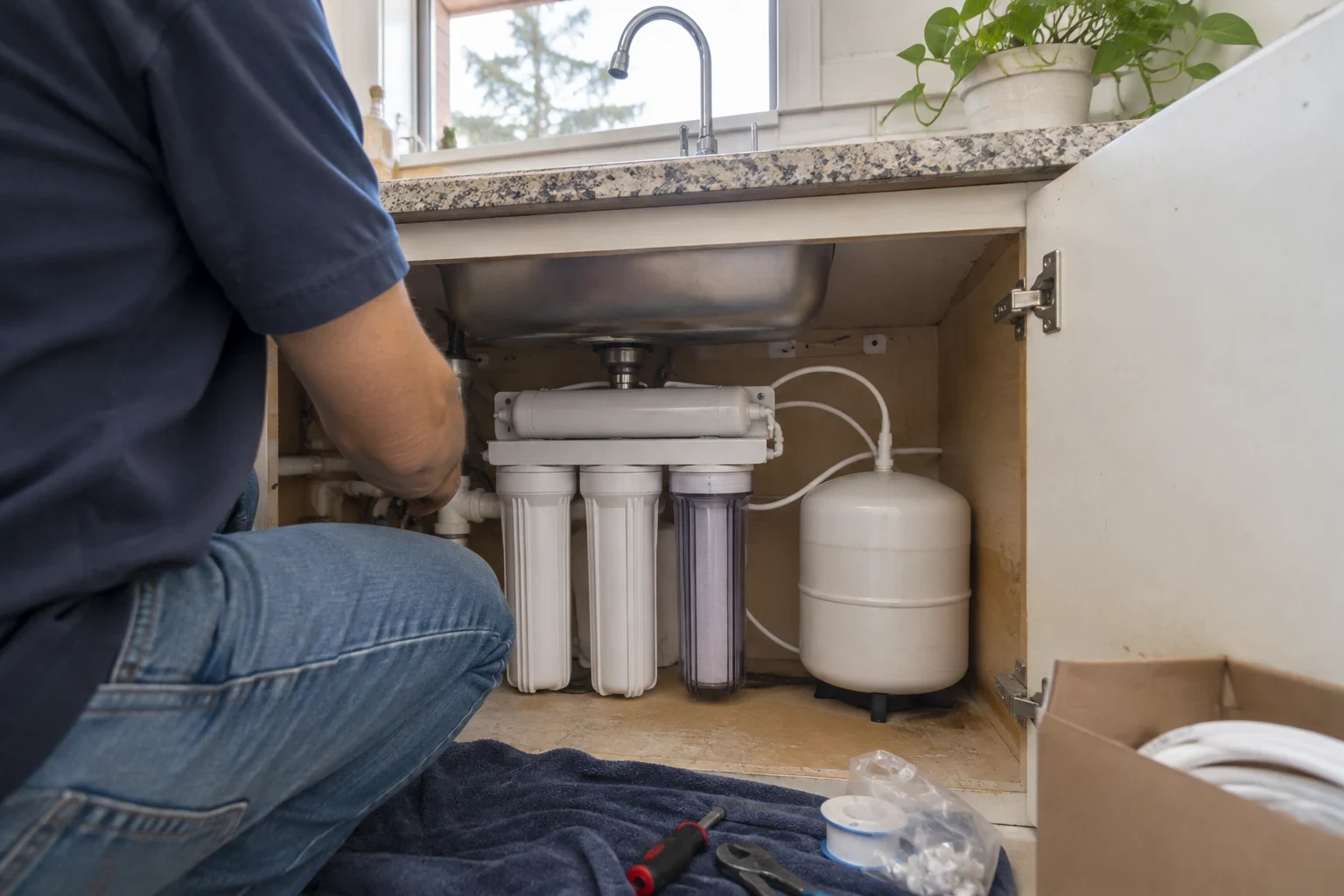
Our under-sink reverse osmosis setups send your cold water across a fine membrane and then to a faucet of its own beside the main tap. You get cleaner-tasting water for glasses, pots and coffee, far fewer bottles to buy, and a cartridge schedule that is easy to follow.
How Reverse Osmosis Cleans Your Water
The system relies on the pressure already in your supply line to drive water across a semi-permeable membrane. Its openings are smaller than a dissolved mineral ion, so most dissolved solids, including lead, nitrate, fluoride and the scale-forming salts that whiten a kettle, are held back and flushed away. Filtered water then fills a small pressurized tank, or on tankless units goes directly to the faucet.
RO serves a single sink, almost always the kitchen, where the water you drink and cook with comes from. It does not treat showers, laundry or other taps. For that, see our City Water Filtration and Dual Tank Water Filtration pages, which describe equipment installed on the main line.
Much of the water piped into Southern California carries a disinfectant residue that people notice in the glass. An RO system takes care of that taste early, since the carbon prefilter must remove it before the water reaches the membrane, or the membrane would wear out.

Parts We Install With Every RO System
- 01
Sediment and carbon prefilters
The first cartridge traps grit and rust particles that older supply lines shed. Next, a carbon block pulls out chlorine and chloramine, which would slowly degrade the thin-film composite membrane if they reached it.
- 02
Membrane and pressure tank
We match the membrane's daily output to how much water your household uses, and choose a bladder tank that fits your cabinet. For tankless models, we make sure an outlet is available for the onboard pump.
- 03
Polishing filter and faucet
Water resting in the storage tank can develop a faint stale note, so a final carbon stage clears it on the way to the faucet. The faucet goes into your spare sprayer hole, or we drill a new opening, stone countertops included.
- 04
Drain connection and air gap
Rinse water exits through a clamp-on saddle fitted to the sink drain above the P-trap. Where the layout calls for it, an air-gap faucet keeps drain water from ever being pulled back toward the filters.
- 05
Optional fridge line
We can extend tubing to your refrigerator so its dispenser and ice maker draw filtered water. Most people notice clearer cubes and a cleaner taste right away.
Questions about Reverse Osmosis?
Call(310) 340-6137When an RO Faucet Is Worth Adding
Cases of bottled water keep piling up
If you buy bottles because the tap tastes wrong, a dedicated RO faucet gives you drinking water straight from your own sink instead.
Coffee or tea tastes dull
Leftover disinfectant and dissolved minerals both affect extraction. Taking them out usually restores the flavor.
Chalky film on kettles and trays
That white residue is calcium and magnesium left behind as water evaporates. The membrane removes most of it from the water you boil and freeze.
Your home has older pipes
Galvanized lines and old lead solder can add metals after water leaves the utility main. A membrane system designed for lead reduction deals with it at the tap you actually drink from.
Ice comes out cloudy
Dissolved solids and trapped air make cubes murky. Water from an RO system freezes visibly clearer.
How the Install Day Runs
- 1
We look at the cabinet first
We check space beside the garbage disposal, the cold-water shutoff and the drain layout. We also photograph the cabinet floor and note any existing stains or soft spots, so you have a dated record of its condition.
- 2
Pressure check
RO membranes need steady feed pressure to work well, typically above 40 psi. We put a gauge on the line, and if pressure is low we explain whether a booster pump is worth adding.
- 3
Mount, connect and flush
We mount the filter head, tap the cold line with a feed adapter and shutoff, install the drain saddle and faucet, and run the first tanks to drain to flush carbon fines out of the new cartridges.
- 4
Leak check and walkthrough
We pressure the system, dry every fitting and recheck it after the tank fills. Then we show you where the shutoff is, which cartridge is which, and when each one is due.
What Changes the Price of an RO System
Labor is not on your bill, because our offer is free install (we cover the cost). What you pay comes down to the equipment and any extras your kitchen calls for. We go through each line by phone before anything is ordered, so you know what each part does and why it is there.
- Storage tank vs. tankless
- A tank model relies on line pressure and has fewer components to wear out. A tankless unit frees up cabinet space and sends less water to the drain, but it carries a pump and a control board.
- Extra cartridges
- A remineralizing stage sits after the membrane and doses trace calcium and magnesium into the water, which many people find makes it taste less flat. It is one more part with its own replacement interval.
- Ice maker hookup
- The cost of a fridge line depends on how far the tubing travels and whether it has to pass through cabinet walls or the floor.
- Weak feed pressure
- When the gauge shows low pressure, a booster pump lets the membrane reach its rated output. That adds hardware and needs a nearby outlet.
Common Reverse Osmosis Questions
How much water goes down the drain with RO?
Any membrane needs a rinse stream to carry rejected solids away, so some water always goes to the drain. Older units could send several gallons out for each gallon made. Newer high-efficiency and tankless designs send much less. We give you the drain ratio of the specific model before you choose.
Will RO strip out minerals my body needs?
The membrane cannot sort a useful mineral from an unwanted one, so it rejects most of both. In a typical diet, meals supply far more calcium and magnesium than a glass of water ever does. If you prefer water with a bit of mineral character, a remineralizing cartridge puts some back.
How often do the cartridges get replaced?
Sediment and carbon prefilters usually run six to twelve months, depending on how much water you use and what comes in from the main. The membrane tends to last two to three years if the carbon stage is swapped on schedule. Each housing gets a label so you can see what is due next.
Is there room under a sink that already has a disposal?
In most kitchens, yes. The filter manifold hangs on a cabinet side wall, and the tank can sit upright or lie on its side. When the space is truly cramped, a tankless model usually solves it.
What happens if you find water damage in the cabinet?
Before we install anything, we photograph and write down what we see, such as staining, delamination or swollen panels. You keep those dated photos. If you choose to file a homeowner's claim, we can describe what we observed, but coverage is decided by your insurer and adjuster, not by us.
Plan the RO System for Your Kitchen
Give us the basics: cabinet size, whether you have a disposal and if the fridge should get RO water too. We will lay out the system that fits and what the install involves before any work starts.